

Egypt PDPL Compliance Guide: What Your Cloud Infrastructure Must Support
April 20, 2026
GPU Cloud Computing in the Middle East: What Enterprise AI Teams Need to Know
May 5, 2026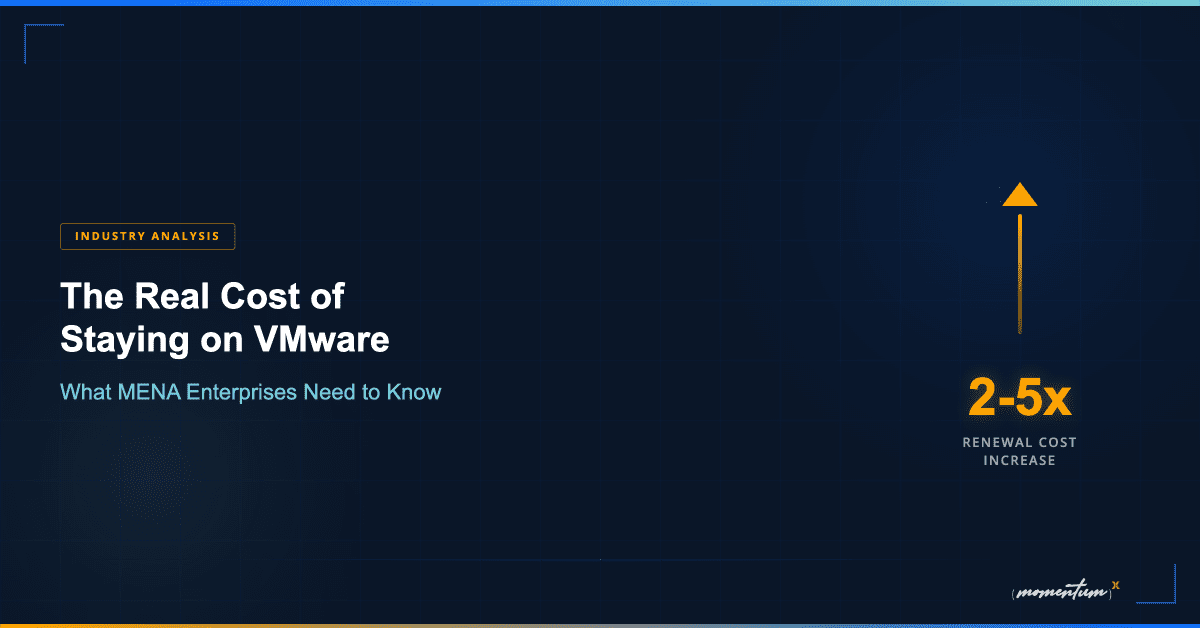
By early 2026, every IT leader across the Middle East has heard the same story from a peer, a partner, or their own procurement team: the VMware renewal quote came in at three, four, sometimes five times the previous contract value. The numbers are not exaggerations. They are the predictable outcome of a restructuring that fundamentally changed how VMware is licensed, sold, and supported. And for enterprises in Saudi Arabia, Egypt, and the UAE — where compliance obligations add a layer of complexity that many global vendors underestimate — the financial impact extends far beyond the line items on the quote.
This article breaks down exactly what changed, what it actually costs, and how to determine whether staying on VMware still makes financial sense for your organization.
What Changed in VMware’s Licensing
When Broadcom completed its acquisition of VMware in late 2023, it moved quickly to restructure the business. The changes were not subtle:
Perpetual licenses eliminated. Enterprises that had purchased VMware licenses outright — and paid annual support and subscription fees to keep them current — lost the option to continue that model. All licensing shifted to subscription-only. For organizations that had amortized their VMware investment over five to seven years, this forced a shift from capital expenditure to recurring operational expenditure, often at significantly higher price points.
Product bundles consolidated. VMware’s sprawling product portfolio was compressed into a small number of subscription bundles. VMware Cloud Foundation (VCF) became the primary enterprise offering, bundling vSphere, vSAN, NSX, and Aria into a single package. The problem: many enterprises only used vSphere and perhaps vSAN. Under the new model, they are paying for a full stack whether they need it or not.
Per-socket licensing replaced by per-core. The shift from per-socket to per-core pricing was particularly painful for enterprises running modern, high-core-count processors. A two-socket server with 64-core processors went from two license units to 128, with minimum core commitments adding further cost pressure.
Channel partner ecosystem reduced. Broadcom significantly reduced the number of authorized VMware partners and resellers worldwide. In the MENA region, where enterprises rely heavily on local systems integrators and managed service providers, this meant that trusted partners who had managed VMware environments for years suddenly lost their authorization. Enterprises were left with fewer options for procurement, support, and managed services.
The Financial Impact for MENA Enterprises
The headline number — renewal costs increasing 2x to 5x — is real, but it only captures part of the picture. For a typical mid-size enterprise in Saudi Arabia or Egypt running 200 to 500 virtual machines on VMware, the financial impact breaks down across several dimensions.
Direct License Cost Increases
An enterprise previously paying $150,000 to $250,000 annually for VMware vSphere and vSAN support renewals can expect new subscription quotes in the range of $400,000 to $1,000,000 for VMware Cloud Foundation. The variance depends on core count, the specific bundle tier, and negotiation leverage — but the floor has moved dramatically upward.
For organizations that were running perpetual licenses with minimal annual costs, the shock is even greater. Moving from a $30,000-per-year support renewal to a $500,000-per-year subscription is not a rounding error. It is a budget event that requires CFO-level attention.
Forced Bundling Costs
The consolidation into VCF bundles means enterprises are paying for NSX (network virtualization), Aria (operations management), and other components they may have never deployed. In practice, we see organizations paying 30 to 50 percent more than they would under an a-la-carte model that matched their actual usage.
Reduced Negotiation Leverage
With fewer authorized partners in the region, enterprises have less competitive pressure to drive pricing down. The partner who managed your VMware estate for the last decade may no longer be authorized to sell or renew licenses. The replacement partner has no history with your environment and limited incentive to offer aggressive pricing.
The Hidden Costs Most Teams Miss
The renewal quote is the cost that triggers the conversation. But the total cost of this transition extends into areas that rarely appear on procurement spreadsheets.
Staff Re-Certification
VMware certifications (VCP, VCAP) are being restructured alongside the product changes. Engineers who held current certifications may need to re-certify under new programs. For an enterprise with a team of four to six VMware-certified engineers, re-certification costs — including exam fees, training courses, and time away from production work — can run $30,000 to $60,000.
Operational Disruption During License Transitions
The shift from perpetual to subscription licensing is not just a procurement event. It often requires changes to licensing keys, entitlement portals, and support agreements. For enterprises with complex environments spanning multiple data centers, the administrative overhead of managing this transition can consume weeks of IT staff time.
Compliance Documentation Updates
For enterprises regulated under NCA, SAMA, or PDPL frameworks, any change to infrastructure licensing or vendor relationships triggers compliance documentation updates. If your VMware partner changes, your vendor risk assessment must be updated. If your licensing model changes, your cost allocation models for regulated workloads must be revised. If the new support structure changes which personnel have access to your environment, your access control documentation needs review.
These are not optional activities for regulated enterprises. They are audit requirements.
Reduced Ecosystem Choice
As Broadcom narrows the VMware partner ecosystem, enterprises lose access to specialized skills. The integration partner who knew your specific VMware-plus-NetApp configuration, or the managed service provider who handled your VMware patching cycle — if they lost their VMware authorization, that expertise is no longer available through the same commercial relationship.
When Does Migration Make Financial Sense?
Not every enterprise should migrate off VMware immediately. The decision depends on a straightforward financial analysis that compares the cost of staying against the cost of moving.
The Stay Calculation
Add up the following for a three-year horizon: new VMware subscription costs at quoted rates, staff re-certification costs, compliance documentation updates for the new licensing model, and any increased support costs due to partner changes. This is your three-year cost to stay.
The Move Calculation
Add up: alternative platform licensing costs (which may be zero for OpenStack-based solutions), migration project costs (assessment, execution, testing, rollback planning), staff retraining on the new platform, temporary parallel infrastructure during migration, and compliance documentation for the new environment. This is your three-year cost to move.
The Break-Even Framework
For most enterprises we work with, migration breaks even within 12 to 18 months when the VMware renewal represents a 3x or greater increase over previous costs. At 2x increases, the break-even point extends to 18 to 24 months. Below 2x, the financial case for migration is weaker, and the decision becomes more about strategic risk — namely, whether you expect future pricing actions to push costs higher still.
The critical factor is operational cost after migration. If you migrate to a platform that requires the same or greater operational effort as VMware, you have only shifted cost from licensing to labour. The financial case for migration is strongest when the target platform includes managed operations — where the provider handles day-to-day infrastructure management, patching, and monitoring.
What to Look for in an Alternative
For MENA enterprises evaluating alternatives to VMware, the checklist extends beyond feature parity with vSphere. The right alternative must address the structural problems that made this situation so disruptive in the first place.
No Vendor Lock-In
If you migrate from one proprietary platform to another, you are resetting the clock on the same risk. When the new vendor’s ownership changes or pricing strategy shifts, you will face the same conversation again. Open-source foundations — particularly OpenStack — eliminate this risk because the platform is not controlled by any single commercial entity.
Data Sovereignty by Design
Any alternative must maintain data residency within your regulatory jurisdiction. This is non-negotiable for enterprises under NCA, SAMA, or PDPL frameworks. The platform, its management plane, its telemetry, and its update mechanisms must all operate within approved boundaries. Verify this explicitly — do not assume it.
Managed Operations Available
The total cost of ownership for any infrastructure platform is dominated by operational costs, not licensing. An alternative that costs nothing to license but requires a team of eight engineers to operate may be more expensive than VMware. Look for providers that offer fully managed operations — including monitoring, patching, capacity planning, and incident response — as part of the service.
Compliance-Native Architecture
Your compliance requirements should not be an afterthought that gets addressed through bolt-on configurations. The alternative should be architected from the ground up for the regulatory frameworks applicable to your industry and geography. Ask to see compliance documentation before you sign, not after deployment.
Clear Migration Path
The provider should demonstrate a proven methodology for migrating workloads from VMware environments with minimal disruption. This includes assessment tooling, staged migration plans, rollback procedures, and compliance continuity throughout the transition.
How MomentumX Addresses This
MomentumX provides OpenStack-based private cloud infrastructure — both as a managed cloud service (Hyper Private Cloud) and as on-premise hyper-converged appliances (HyperEdge 500) — deployed and operated entirely within Egypt and Saudi Arabia.
For enterprises evaluating their VMware position, we offer migration assessments that quantify the cost comparison specific to your environment, managed migration execution that maintains compliance continuity throughout the transition, and ongoing managed operations that keep total cost of ownership predictable.
Our infrastructure is built for NCA, SAMA, and PDPL compliance from the architecture level — not bolted on after the fact. There are no per-core licensing surprises, no forced bundling, and no single-vendor lock-in.
If your VMware renewal conversation has raised questions about cost, risk, or long-term sustainability, we should talk.
Contact MomentumX at momentumx.cloud/contact-us
VMware, vSphere, vSAN, NSX, Aria, and VMware Cloud Foundation are trademarks of Broadcom Inc. and/or its subsidiaries. Nutanix is a trademark of Nutanix, Inc. All other trademarks are the property of their respective owners. This article is for informational purposes only and does not constitute legal or financial advice.
Calculate your real Broadcom escape cost in 30 seconds.
Three inputs — VMware annual spend, CPU cores, storage TB. We’ll show you a 3-year TCO comparison vs HyperEdge 500 and tell you exactly what your savings look like. No form, no email gate.
Ready to move to sovereign cloud?
MomentumX provides sovereign cloud infrastructure across Egypt, KSA, and UAE with full SAMA, NCA, and PDPL compliance. Your data stays in your country.
Enterprise Private CloudHyperAI
GPU Compute for AIHyper Private Cloud
Managed Private Cloud