

GPU Cloud Computing in the Middle East: What Enterprise AI Teams Need to Know
May 5, 2026
VMware Migration Guide for MENA Enterprises: Your Options After Broadcom
May 8, 2026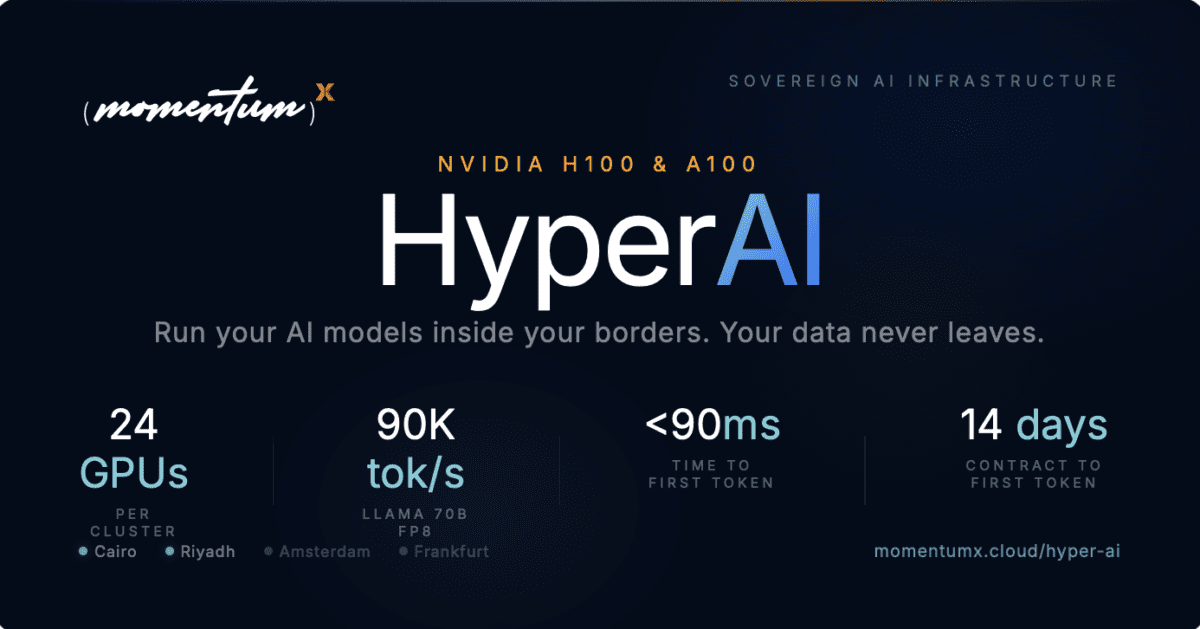
Every enterprise in the region is exploring AI. But most are making a critical mistake: they’re building on infrastructure that sends their most sensitive data across borders.
When an enterprise fine-tunes a large language model, three things leave the country before a single inference returns: training data, model weights, and inference logs. For a bank in Riyadh processing loan applications through AI, that means customer financial data crossing jurisdictional boundaries. For a healthcare provider in Cairo using AI-assisted diagnostics, it means patient records leaving Egypt.
This isn’t a theoretical risk. It’s a compliance gap that regulators are actively closing.
The Regulatory Reality
Across MENA, data protection frameworks are moving from guidelines to enforcement. Financial regulators require that sensitive workloads run on infrastructure that meets specific residency and audit requirements. National cybersecurity authorities are tightening cloud classification standards. Data protection laws now carry real penalties.
For enterprises in regulated industries — financial services, healthcare, government, telecom — the question is no longer whether to adopt AI. It’s whether their AI infrastructure can survive an audit.
Why Hyperscaler Regions Aren’t Enough
Having a cloud region in-country doesn’t solve the problem. Cross-border legal frameworks can compel data disclosure regardless of where the server physically sits. Shared infrastructure means shared risk. And most global cloud providers can’t guarantee that model weights, training pipelines, and inference logs all remain within a single jurisdiction.
Sovereign AI infrastructure is different. It means the compute, the storage, the network fabric, and the control plane all operate under local jurisdiction — with customer-managed encryption keys and a full audit trail.
What Sovereign AI Looks Like in Practice
A sovereign AI deployment starts with dedicated GPU compute — the same NVIDIA H100 and A100 accelerators that power the world’s largest AI models — running inside a local data center. The enterprise controls the keys. The data never crosses a border. Pre-integrated open-weight models like Llama, Mixtral, Falcon, and Jais are ready to deploy on day one.
The result: enterprises can run AI workloads that meet regulatory requirements without sacrificing performance. A properly configured sovereign AI cluster delivers 90,000 tokens per second on Llama 70B, with time-to-first-token under 90 milliseconds — performance that matches or exceeds what global providers offer, but with full data sovereignty.
The 14-Day Proof of Concept
The best way to evaluate sovereign AI isn’t a slide deck — it’s a real workload on real hardware. That’s why MomentumX offers a 14-day proof of concept: bring your model, your data, and your use case. Run it on dedicated GPU infrastructure in Cairo or Riyadh. Measure the performance, verify the compliance posture, and make a decision based on evidence.
From signed contract to first token in 14 days. No lock-in. No data leaving your borders.
If your enterprise is exploring AI and compliance matters, the conversation starts at momentumx.cloud/hyper-ai.
Ready to move to sovereign cloud?
MomentumX provides sovereign cloud infrastructure across Egypt, KSA, and UAE with full SAMA, NCA, and PDPL compliance. Your data stays in your country.
Enterprise Private CloudHyperAI
GPU Compute for AIHyper Private Cloud
Managed Private Cloud