

Why Sovereign AI Is Now a Business Requirement for MENA Enterprises
May 6, 2026
NCA Cloud Compliance Checklist for Enterprises in Saudi Arabia
May 10, 2026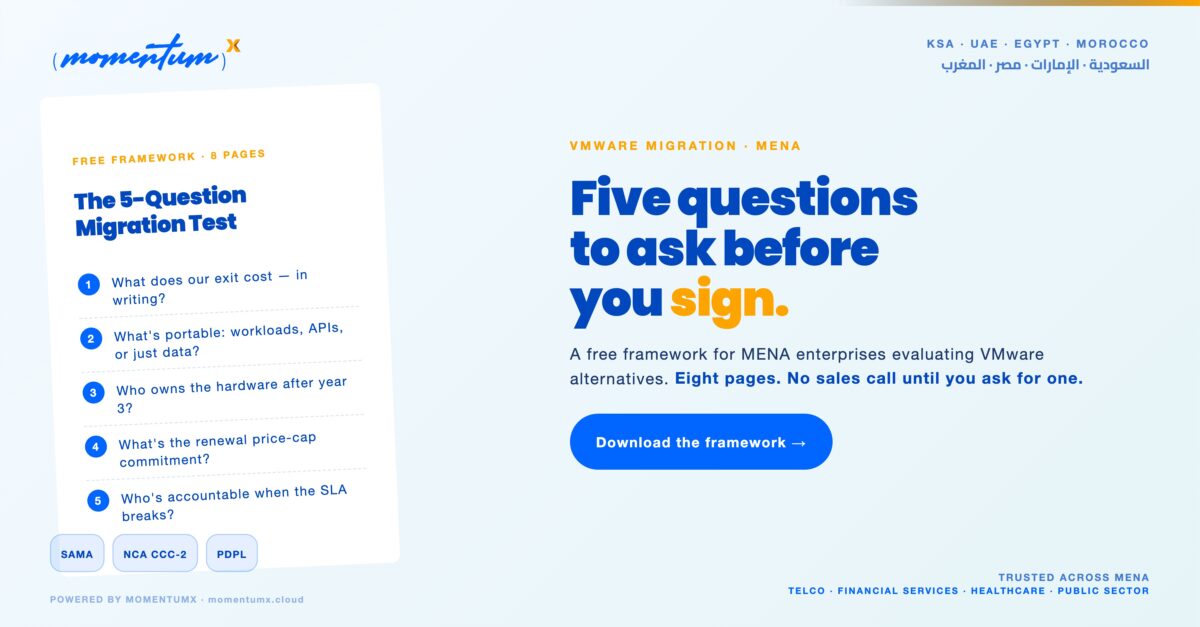
The MENA enterprise guide
Don’t trade a cage
for another.
Choosing what comes after VMware — without locking yourself into the next vendor.
Built on OpenStack since 2018. Seven years before Broadcom’s licensing hike forced the rest of the industry to act. We wrote down what we’ve learned — the math, the compliance reality, the migration playbook — so MENA CIOs don’t have to figure it out alone.
30-second request · sent immediately · no sales call until you ask
7
years on OpenStack before Broadcom
3
MENA data centers, sovereign
< 7 weeks
PO → migrated & running
By MomentumX · Updated 2026-05-17 · 11 min read
The Broadcom acquisition of VMware changed the economics of enterprise virtualisation overnight. Across the Middle East and North Africa, IT leaders are facing renewal quotes two to five times higher than previous contracts, perpetual licences phased out in favour of subscription bundles, and partner relationships disrupted. For organisations operating under NCA, SAMA, or PDPL, the disruption is not just commercial — it is regulatory.
This guide is the direct path off VMware for MENA enterprises: what is at stake, what the migration actually looks like, and how to get to production on sovereign infrastructure in under seven weeks — six for the hardware to land, fewer than seven days for the migration itself.
The Broadcom Shock
Three things have shifted at once:
- Perpetual licences retired in favour of subscription bundles, with steep renewal increases now standard.
- Pricing tiers consolidated, forcing customers into higher-cost packages that include products they do not use.
- Channel disruption — authorised partner statuses have changed, support paths have been reorganised, and several regional integrators have lost their VMware accreditation.
For MENA enterprises this also coincides with national data-sovereignty pressure. Workloads must stay in-country; auditors increasingly ask where the infrastructure provider is incorporated, not just where the data sits. Some Tier-1 banks in KSA and Egypt are now being asked, at renewal, to demonstrate that a US-based subscription model still satisfies SAMA and NCA expectations on operational continuity and supply-chain risk.
What You Are Actually Choosing
The temptation in the room is to treat this as a procurement event — renegotiate, switch SKUs, accept the new bundle. That misses the deeper question.
You are choosing between two architectures:
- A closed stack with a single commercial owner — VMware now, Nutanix or Hyper-V tomorrow. Pricing, roadmap, and channel sit with one vendor in another jurisdiction.
- An open, standards-based stack with regional jurisdiction — OpenStack and Ceph, operated in MENA, with the source code, governance, and support contract all visible and replaceable.
Either is technically valid. The difference shows up in year three — when the renewal sits on your desk and you discover whether your vendor’s incentives still match yours.
HyperEdge 500 — Built for the MENA Exit
HyperEdge 500 is MomentumX’s appliance-form private cloud. We have been running production OpenStack since 2018 — seven years before Broadcom’s licensing reset forced the rest of the industry to look at alternatives. The appliance ships pre-configured for an enterprise VMware-replacement workload, with NCA, SAMA and PDPL compliance baked in at the platform layer rather than bolted on afterwards.
Three tiers — Standard (128 cores), Advanced (384 cores), and GEM (up to 1,152 cores, 18 TB DDR5, 1.4 PB NVMe per 3-node cluster) — cover everything from departmental virtualisation up to a Tier-1 bank’s core estate. Storage is Ceph with 3× replication; networking runs a 200 Gbps internal fabric on PCIe 5.0; OS is Ubuntu 22.04 LTS; OpenStack 2024.1 Caracal / Dalmatian is current. SLAs ladder from 99.9% Standard up to 99.99% Mission Critical.
The appliance is racked at your data centre — Egypt, KSA, or wherever your regulator requires — and you operate it directly. There is no shared multi-tenancy you cannot see, no foreign jurisdiction in the contract, and no licence audit clause you didn’t agree to twice.
From PO to Production — a 7-Week Sequence
The number most teams get wrong when modelling a VMware exit is “how long does the migration take?” They picture months of disruption. The actual sequence has two phases — and only one of them touches your VMs.
Phase A — 6 weeks from PO to migration-ready. Hardware procurement is the critical path. Workload discovery, design, and operational integration all run in parallel with shipping.
Phase B — Less than 1 week to migrate. Using MomentumX’s migration tool on a workload set already understood from Phase A. No professional-services scope creep, no third-party tooling, no orphan formats.
Phase A — the 6 weeks from PO to a HyperEdge 500 in your rack
Three tracks run concurrently. The critical path is hardware delivery; everything else fits within that window.
Hardware track: Week 1 — PO signed, MomentumX triggers cluster build (Standard / Advanced / GEM tier confirmed). Weeks 2–3 — Assembly, burn-in, OpenStack 2024.1 + Ceph Reef pre-staged. Week 4 — Freight to Egypt or KSA. Week 5 — Customs clearance, transport to your data centre, racking. Week 6 — Power-on, base config, network integration with your existing infrastructure, storage pools live.
Workload-discovery track (runs in parallel): Full VMware estate audit, workload-to-cluster mapping, compliance scope (NCA / SAMA / PDPL), migration design document, customer sign-off, pre-flight testing of the MomentumX migration tool against representative samples of your VM image formats.
Integration track (runs in parallel): Active Directory / LDAP federation, backup integration with your DR site, SIEM / monitoring connection, ITSM integration, compliance documentation pre-populated for evidence packs.
End of week 6: the HyperEdge 500 is physically in your rack, fully operational, ready to receive VMs. Your team has signed off on the migration design. Runbooks are written.
Phase B — the migration itself, under one week
This is the part most teams expect to be the hard part. It isn’t, because everything that makes migration hard — discovery, design, integration, capacity sizing, rollback planning — was already done during Phase A.
Days 1–2: Pilot wave — 5 to 15 non-critical VMs migrated via MomentumX’s migration tool. Live VM transfer, typically 5–15 minutes of cutover per VM. Validate performance, networking, storage IOPS, backup/restore, failover.
Days 3–4: First production wave — 25–40% of production VMs migrated in maintenance windows you schedule. Each migration monitored live; per-VM rollback plan ready.
Days 5–6: Final production wave — the remaining 60–75%. External integrations cut over (firewalls, load balancers, DNS).
Day 7: Stabilisation, hand-off to your operations team. Old VMware environment held in standby for 30 days for rollback safety, then decommissioned.
End of week 7: every VM is running on sovereign infrastructure. VMware licences ready for non-renewal.
A 200-VM mid-sized estate runs through this 7-week sequence with no production downtime beyond the per-VM maintenance windows the customer chooses. Larger environments (500+ VMs) extend Phase B from one week to two — total elapsed time 8 weeks from PO, not 12+. The bottleneck is coordination — change-control boards, security reviews, stakeholder sign-off — not the technology.
Compliance Outcomes — NCA / SAMA / PDPL on Day One
This is where most VMware replacements fall over. The platform is technically excellent and audit-disaster simultaneously. HyperEdge 500 is engineered the other way: compliance evidence is generated by the platform, not by your team in a spreadsheet at midnight.
- Data residency: physical hardware in-country. Cluster never replicates outside the boundary you set. Contract governed by the law of the jurisdiction where the cluster runs.
- NCA Essential Cybersecurity Controls (CCC-2): aligned out-of-the-box — encryption-at-rest (AES-256 LUKS), audit logging, role-based access, configurable retention, and tested DR. Evidence pack pre-populated, ready for review by your CISO before the auditor sees it.
- SAMA Cybersecurity Framework: 24-hour incident notification SLA, contractual RTO/RPO, and tested DR runbook included by default. Operational risk register handed over at deployment.
- PDPL (KSA / UAE / Egypt): data subject access controls supported at the platform layer; cross-border transfer disabled unless you explicitly enable it; processor-controller relationship made contractually explicit.
- CLOUD Act exposure: none. MomentumX is a MENA entity; no parent company is subject to US jurisdiction.
What This Costs versus Staying on VMware
Direct three-year comparison for a representative mid-sized MENA enterprise (200 VMs, mixed production / dev / DR):
- Year 1 VMware renewal (typical 2.5–4× uplift): approximately $400–650K in licences and support, before professional services, hardware refresh, or migration costs.
- Year 1 HyperEdge 500 (Advanced tier, three-year): approximately $280–360K all-in (hardware, software, support, migration). No per-VM, per-core, or per-feature meters.
- Year 2 renewal — VMware: typically 10–25% increase. HyperEdge: no licence renewal; support contract fixed for the term.
- Year 3 — VMware: 10–30% further increase (Broadcom’s pattern from the CA Technologies acquisition).
Most MENA enterprises see HyperEdge 500 pay for itself in month 14–18, with the migration window being the most expensive period. After that the curve flattens. The complete guide contains the full per-country, per-VM-band breakdown for KSA, UAE, and Egypt.
Get the migration guide
The article above is the executive summary. The migration guide goes deeper:
- → The Broadcom renewal math: year-by-year projections for KSA, UAE, and Egyptian enterprises with 50, 200, and 500 VM environments
- → Three migration paths compared: Open HCI (us), Nutanix AHV, Hyper-V — analysed against MENA compliance and TCO
- → The lock-in test: 7 questions every CIO should ask any vendor before committing to a 3-year contract
- → NCA CCC-2 / SAMA / PDPL compliance scorecard — print-ready, with a self-assessment template
- → What our customers wish they had known in year 1
Instant download once you tell us where to send it. No automated drip. No sales follow-up unless you ask.
Already done the math? Skip ahead and book a 30-min architecture walkthrough →
Ready to talk?
We don’t do sales theatre. A 30-minute conversation with our architecture team — we’ll review your specific environment, the renewal math, and the compliance constraints you’re navigating. If we’re not a fit, we’ll tell you. If we are, we’ll show you what the migration actually looks like.
Ready to move to sovereign cloud?
MomentumX provides sovereign cloud infrastructure across Egypt, KSA, and UAE with full SAMA, NCA, and PDPL compliance. Your data stays in your country.
Enterprise Private CloudHyperAI
GPU Compute for AIHyper Private Cloud
Managed Private Cloud