
Private Cloud for MENA Construction and Infrastructure Projects: Why Project Data Cannot Live on Generic Cloud
October 26, 2026
Bare Metal Cloud for MENA Financial Services: Why Shared Compute Cannot Handle Trading and Core Banking Workloads
November 2, 2026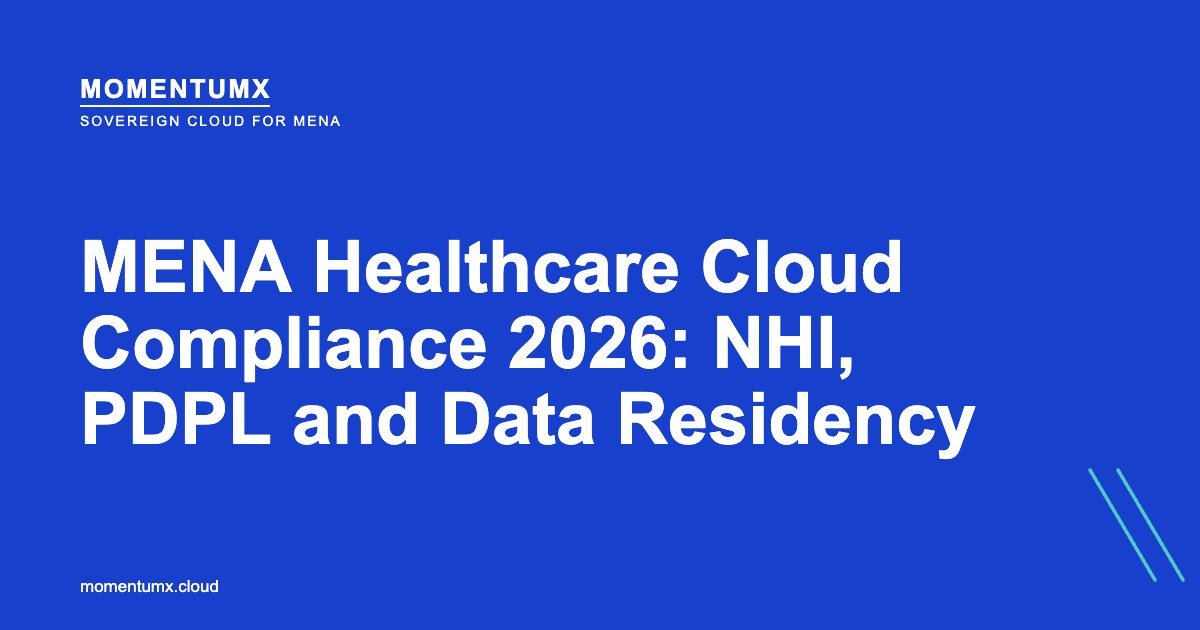
Healthcare data is among the most regulated categories of information in the UAE, Saudi Arabia, and Egypt — and it is also among the most frequently mishandled when organisations move to cloud. Hospitals, diagnostic chains, health insurance platforms, and digital health startups across the region have adopted public cloud infrastructure with the assumption that contractual data processing agreements are sufficient to satisfy local regulatory obligations. They are not. What regulators in all three markets are increasingly demanding is not a signed document asserting data residency — it is verifiable, auditable, architectural proof that patient data never traverses infrastructure outside the jurisdiction. That distinction is where most cloud deployments in MENA healthcare currently fail.The Regulatory Baseline Across UAE, KSA, and EgyptEach of the three primary MENA markets has developed distinct but directionally consistent requirements for health data governance. Understanding these in isolation is necessary before designing any shared or multi-jurisdiction infrastructure strategy.UAE: ADHICS, UAE PDPL, and the Health Data LawThe Abu Dhabi Healthcare Information and Cyber Security Standard (ADHICS) imposes explicit controls on where electronic health records and clinical data may be processed and stored. The UAE Personal Data Protection Law, combined with the Federal Health Data Law enacted in 2023, extends these obligations to all entities handling health-related personal data at a federal level. Cloud providers must be able to demonstrate that data is stored exclusively within the UAE, that encryption keys are under the control of the data owner, and that access to patient records cannot be compelled by a foreign government through the provider’s parent entity jurisdiction. Hyperscalers operating under US, EU, or other foreign legal frameworks cannot structurally satisfy this last requirement regardless of where their data centres are physically located.Saudi Arabia: NDMO, NHIC, and NCA CCC-2Saudi Arabia’s National Health Information Centre has issued data classification and governance standards that treat most patient data as sensitive national data subject to localisation. The National Data Management Office framework reinforces mandatory in-Kingdom storage for health records, and NCA CCC-2 cloud cybersecurity controls apply directly to any cloud platform processing this data. Hospitals and health networks operating under Vision 2030’s healthcare transformation agenda are under increasing scrutiny from both the Ministry of Health and regulatory auditors to demonstrate sovereign infrastructure alignment — not just policy compliance.Egypt: PDPL October 2026 Enforcement and MOH RequirementsEgypt’s Personal Data Protection Law enters full enforcement in October 2026. Health data is explicitly classified as sensitive personal data under the Law, requiring explicit consent frameworks, strict processing controls, and — critically — cross-border transfer restrictions that effectively mandate in-country storage for most operational use cases. The Ministry of Health has separately issued guidance on electronic medical record systems requiring that data processed by licensed health facilities remain within Egyptian territory. Organisations that have deferred infrastructure decisions under the assumption that enforcement is distant are now facing a 2026 deadline that leaves little runway for migration.What Sovereign Private Cloud Must Deliver for Healthcare WorkloadsCompliance is a floor, not a ceiling. The infrastructure decisions that healthcare organisations make around cloud architecture will determine not just their regulatory standing but their clinical and operational performance for the next decade. The following requirements are non-negotiable for any serious healthcare cloud deployment in these markets.In-Country Data Residency with Hardware SeparationShared multi-tenant infrastructure — even within a domestic data centre — creates audit complexity that most health regulators will not accept. Patient data must reside on dedicated infrastructure where the physical storage layer, compute resources, and network fabric are not shared with unrelated tenants. This is not a policy preference; it is the technical prerequisite for producing the audit evidence that regulators will require when enforcement actions begin.Encryption Key SovereigntyData encryption is necessary but insufficient if the keys are managed by the infrastructure provider or by a hyperscaler’s key management service. Healthcare organisations must retain exclusive control of encryption keys within a hardware security module that is physically located in the same jurisdiction as the data. Any arrangement where key recovery or escrow access could be initiated by the provider without the customer’s explicit action is incompatible with ADHICS, NCA CCC-2, and Egypt PDPL requirements.Clinical Application Performance and LatencyPACS systems, real-time diagnostic imaging workflows, electronic health record platforms, and clinical decision support tools all have latency profiles that generic cloud infrastructure is not designed to accommodate at scale. Bare metal compute access, NVMe-backed storage with predictable IOPS, and low-latency internal networking are architectural requirements for healthcare cloud — not premium add-ons. Organisations that have attempted to run PACS workloads on standard cloud virtual machines consistently report performance degradation that affects clinical workflow velocity.Disaster Recovery with Defined Clinical RTOHealthcare has a different relationship with downtime than most sectors. A two-hour RTO that would be acceptable for a retail platform becomes clinically dangerous in an emergency department environment. Sovereign disaster recovery architecture for healthcare must support sub-hour RTO for critical clinical systems, with synchronous or near-synchronous replication between primary and secondary sites that are both located within the same jurisdiction. Cross-border DR arrangements that route failover traffic through international links introduce both latency and regulatory exposure simultaneously.The Structural Problem with Hyperscaler Healthcare DeploymentsThe fundamental issue with deploying healthcare workloads on AWS, Azure, or Google Cloud in MENA is not the location of the data centre — it is the legal jurisdiction of the provider. Under the US CLOUD Act, any US-incorporated cloud provider can be compelled to produce data held anywhere in the world in response to a US government order. This applies to AWS, Microsoft, and Google regardless of whether their Middle East regions are physically located in Dubai, Riyadh, or Cairo. No contractual data processing agreement can override this statutory obligation. For a hospital processing patient records — which are by definition sensitive personal data under all three regulatory regimes — this represents an unresolvable compliance exposure.What Healthcare Organisations Should Be Doing NowThe window for orderly migration is closing. Egypt’s October 2026 PDPL enforcement deadline, combined with accelerating audit activity from ADHICS reviewers in the UAE and NCA-aligned inspections in Saudi Arabia, means that healthcare organisations that have not yet initiated a cloud architecture review are already behind. The assessment should begin with a workload classification exercise that maps every clinical and administrative system to its data classification, then evaluates current infrastructure against in-country residency, encryption sovereignty, and DR requirements. The output of that assessment will determine whether existing arrangements can be remediated or whether a structured migration to sovereign private cloud infrastructure is the only viable path to compliance.
Ready to move to sovereign cloud?
MomentumX provides sovereign cloud infrastructure across Egypt, KSA, and UAE with full SAMA, NCA, and PDPL compliance. Your data stays in your country.
Enterprise Private CloudHyperAI
GPU Compute for AIHyper Private Cloud
Managed Private Cloud