Bare Metal Cloud for MENA Financial Services: Why Shared Compute Cannot Handle Trading and Core Banking Workloads
November 2, 2026
Object Storage Architecture on Sovereign Private Cloud: What MENA Enterprises Get Wrong When Scaling Unstructured Data
November 9, 2026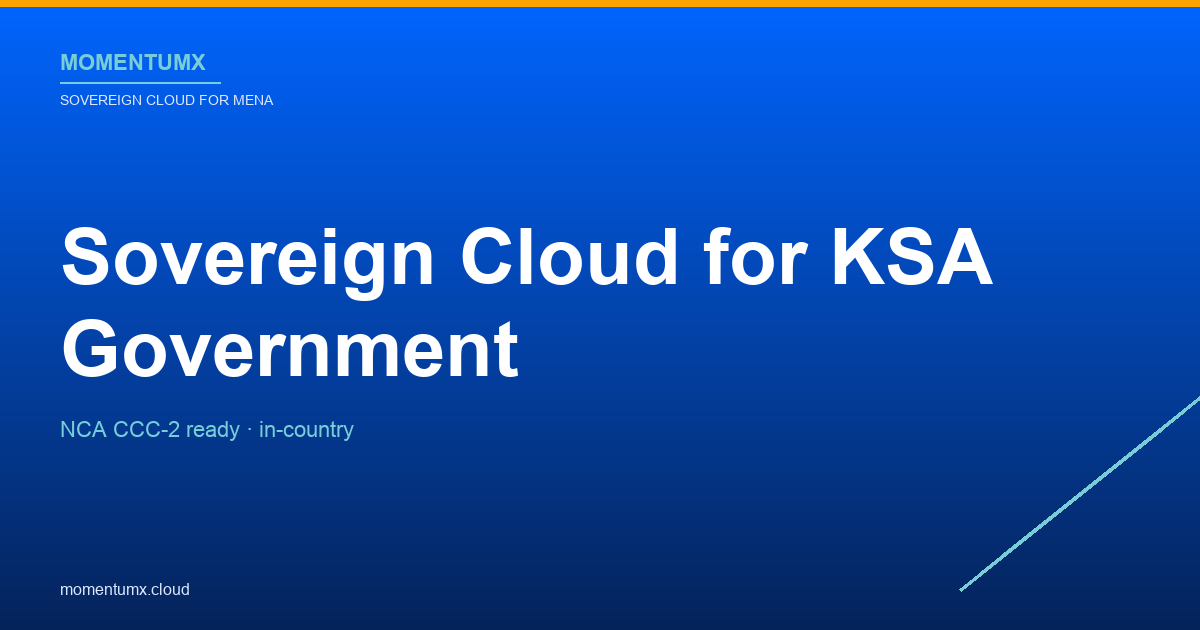
Government entities across the UAE, Saudi Arabia, and Egypt are operating under a set of cloud procurement conditions that did not exist five years ago. Regulatory frameworks have matured, data classification requirements have tightened, and national cybersecurity authorities in all three markets have published binding guidance that directly constrains how public sector workloads may be hosted. What was once a discretionary preference for local infrastructure has become a hard compliance requirement, and procurement teams that continue to evaluate generic global cloud providers on cost and feature parity alone are creating legal and operational exposure that no SLA can indemnify.The Regulatory Baseline Has ChangedEach of the three markets MomentumX serves has established distinct but converging requirements for government cloud infrastructure. In the UAE, the Information Assurance Standards published by the Telecommunications and Digital Government Regulatory Authority set explicit controls around data residency, access management, and incident reporting for government systems. In Saudi Arabia, the National Cybersecurity Authority’s Cloud Cybersecurity Controls (CCC-2) classify government workloads by sensitivity level and mandate that high-impact data remain within nationally controlled infrastructure. In Egypt, the Supreme Cybersecurity Council and the Ministry of Communications have issued directives requiring that sovereign government data be processed on locally hosted platforms, a posture that will gain additional legal weight as the Egypt PDPL enforcement timeline advances through 2026.These are not aspirational guidelines. They carry procurement implications. A government entity that selects a hyperscaler regional zone as its primary cloud environment and cannot demonstrate alignment with these national frameworks is not simply accepting technical risk. It is accepting regulatory non-compliance, and in government contexts, that exposure extends to ministerial accountability.What Sovereign Architecture Actually Means for Government WorkloadsThe term sovereign cloud is used loosely across the market. Vendors apply it to offerings that range from genuinely dedicated national infrastructure to hyperscaler regions with a local SLA attached. Government procurement teams need to understand what the architecture actually delivers, not what the marketing language implies.Physical Infrastructure and Jurisdictional ControlSovereign cloud for government workloads requires that compute, storage, and networking resources are physically located within national territory, operated by an entity subject to local law, and not accessible to foreign administrative or law enforcement processes without formal legal channels. This excludes hyperscaler infrastructure that routes management plane traffic through global control systems, even when data storage nodes are located in-country.Dedicated Tenancy and Access IsolationGovernment workloads classified at restricted or above cannot operate on shared multi-tenant infrastructure where hypervisor-level proximity to commercial tenants creates a theoretical attack surface. Dedicated bare metal or logically isolated private cloud environments are required, with access controls that prevent cloud provider personnel from accessing workload data without documented and auditable authorization.Encryption Key OwnershipKey management is a critical differentiator that procurement evaluations frequently underweight. If the cloud provider controls the encryption keys for government data, the government does not control the data. Sovereign architecture requires that encryption keys remain under government custody, either on-premises in hardware security modules or in key management infrastructure that is contractually and technically isolated from the provider’s global systems.Where Generic Cloud Procurement FailsGovernment entities that have attempted to satisfy sovereignty requirements by selecting hyperscaler local regions consistently encounter the same set of structural limitations.Management plane operations — including provisioning, monitoring, identity federation, and billing — are routed through global infrastructure outside national jurisdiction.Contractual data processing agreements are governed by foreign law, creating conflicts with national data classification frameworks.Incident notification timelines in hyperscaler SLAs frequently exceed the reporting windows mandated by national cybersecurity frameworks.Personnel with access to infrastructure management systems may be located outside the country, violating access control requirements for classified government workloads.Audit rights are limited to what the provider chooses to surface through dashboards and logs, not independent third-party verification of physical and logical controls.These are not edge cases. They are structural features of global cloud architecture that cannot be remediated through contractual addenda or compliance attestations issued by the provider itself.Procurement Evaluation Criteria That Actually MatterGovernment procurement teams should build evaluation frameworks around the following criteria, applied consistently across all shortlisted providers.Data Residency and Jurisdictional ControlRequire providers to document, in contractual terms, that all data processing occurs within national territory and that no data, metadata, or encryption keys transit foreign jurisdictions as part of normal operations.Personnel Access ControlsRequire disclosure of where infrastructure management personnel are located, what access they have to government workloads, and what authorization processes govern that access. Providers that cannot answer this question with specificity should be disqualified.Independent Audit RightsProcurement contracts should include rights to commission independent audits of physical and logical controls, not limited to reviewing provider-issued compliance reports. Hyperscalers routinely restrict audit rights to their own attestations. This is not acceptable for government workloads.Incident Response and NotificationEvaluate incident response SLAs against the specific notification timelines required by TDRA, NCA, and Egyptian national cybersecurity frameworks. Providers that offer generic 72-hour notification windows without alignment to national regulatory timelines are not operationally compliant.Exit and PortabilityGovernment contracts that create workload dependency on proprietary cloud services without documented exit procedures are a long-term risk. Sovereign private cloud built on open standards — including OpenStack-based infrastructure — provides data and workload portability that reduces lock-in and supports future procurement flexibility.What This Means for 2026 Procurement CyclesGovernment entities in the UAE, Saudi Arabia, and Egypt that are entering procurement cycles in 2026 are doing so against a regulatory backdrop that has closed most of the ambiguity that allowed hyperscaler adoption in prior years. The frameworks are specific, the enforcement posture is active, and the consequences of non-compliance are not limited to technical findings — they extend to governance accountability at the institutional level.Sovereign private cloud infrastructure, purpose-built for national regulatory requirements and operated entirely within country, is not a premium option in this environment. It is the baseline against which every other procurement choice must be evaluated. Providers that cannot demonstrate full alignment with national frameworks in the UAE, Saudi Arabia, and Egypt are not viable candidates for government workloads in 2026, regardless of their global market position.
Ready to move to sovereign cloud?
MomentumX provides sovereign cloud infrastructure across Egypt, KSA, and UAE with full SAMA, NCA, and PDPL compliance. Your data stays in your country.
Enterprise Private CloudHyperAI
GPU Compute for AIHyper Private Cloud
Managed Private Cloud