
Egypt PDPL October 2026: 10 Questions to Ask Your Cloud Provider Before Enforcement
July 5, 2026
NCA Cloud Cybersecurity Controls (CCC-2): A Practical Compliance Checklist for Saudi Enterprises
July 5, 2026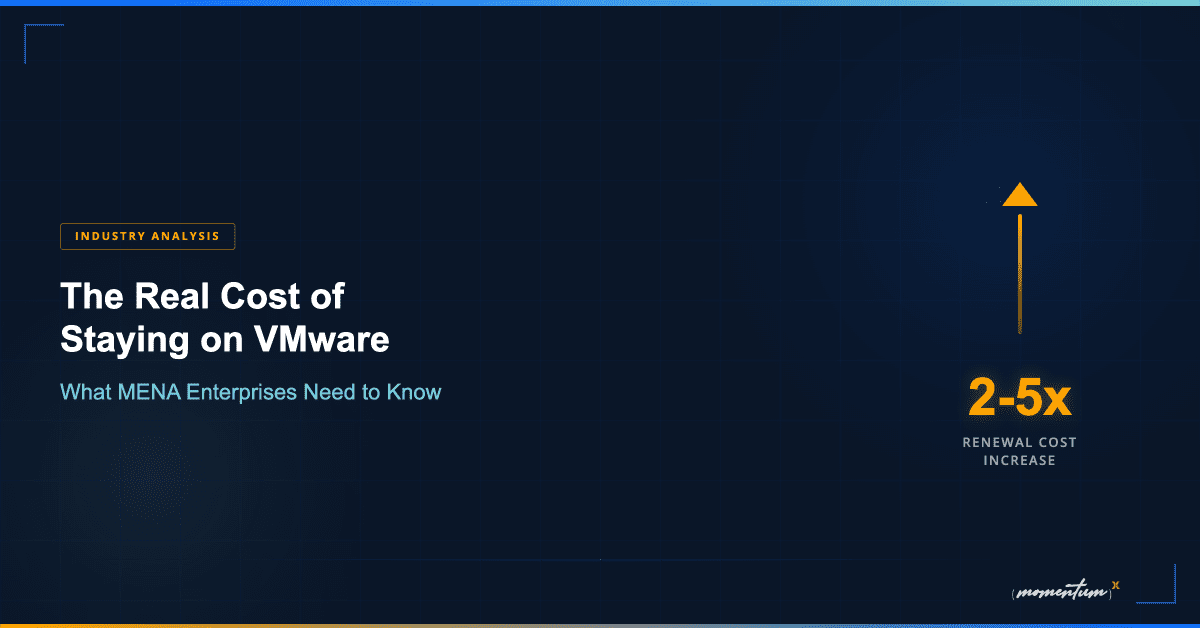
When Broadcom completed its acquisition of VMware in November 2023, the reverberations were felt almost immediately in IT budgets across the Middle East and North Africa. Perpetual licensing — the model that anchored VMware’s commercial relationship with enterprises for two decades — was eliminated overnight. In its place came subscription bundles that, for many organisations, arrived with price increases ranging from 300% to 500%. For IT directors and CTOs still weighing their options, this is no longer a future problem. It is a present-day financial and operational risk that demands a structured response.
The Broadcom Shock: What Actually Changed
The acquisition did more than change ownership. Broadcom restructured VMware’s entire product portfolio, retiring standalone products and forcing customers into VMware Cloud Foundation (VCF) bundles. Organisations that previously paid for specific vSphere, vSAN, or NSX licences now find themselves compelled to purchase capabilities they do not use in order to access those they do.
Compounding the issue is a hard support deadline: VMware vSphere 7 reached End of General Support on April 2, 2025. Enterprises still running vSphere 7 workloads are now operating on unsupported infrastructure. vSphere 8 remains supported, but the cost to upgrade and maintain it under Broadcom’s new pricing model has made the total cost of ownership materially higher than it was 18 months ago.
The Real Cost of Staying on VMware
1. Direct Licensing Expenditure
The shift to per-core subscription pricing, combined with bundle consolidation, has produced renewal invoices that shock even well-prepared procurement teams. A mid-sized MENA enterprise running 200 to 500 virtual machines on VMware can expect annual licensing costs that are 3x to 5x higher than their 2022 baseline — before factoring in support, professional services, or third-party integrations.
2. Vendor Lock-in and Escalation Risk
Broadcom’s business model for enterprise software is well-documented: acquire, bundle, raise prices, retain. Enterprises that do not begin building optionality into their infrastructure architecture now face a future where each renewal cycle is a negotiation conducted from a position of dependency. The longer workloads remain on proprietary hypervisors and management planes, the more expensive and disruptive an eventual migration becomes.
3. Compliance and Security Exposure
For organisations operating under UAE IA, Saudi NCA, or other regional compliance frameworks, running workloads on unsupported infrastructure versions introduces auditability risk. An environment running vSphere 7 post-April 2025 without a documented remediation plan is a finding waiting to happen.
The Cost of Migrating to HCI on Open Standards
Hyperconverged infrastructure built on open-source OpenStack and KVM presents a structurally different cost model. Independent benchmarks and customer case studies consistently show total cost of ownership reductions of 40% to 60% over a five-year horizon when comparing open-source HCI to equivalent VMware deployments under Broadcom’s current pricing.
The sources of that reduction are concrete:
- No hypervisor licensing fees. KVM is kernel-native and carries no per-core cost. OpenStack is Apache-licensed. The savings on licensing alone frequently offset the full cost of migration within 18 to 24 months.
- Commodity hardware compatibility. Open-source HCI is not tied to a certified hardware programme with artificial margin built in. Procurement becomes competitive.
- Cost predictability. Subscription renewals do not exist for the core platform. Operational costs are driven by infrastructure and staffing, both within the enterprise’s control.
- Sovereign data control. For MENA enterprises with data residency obligations, on-premises or regionally-hosted open HCI removes the ambiguity that cloud-hosted VMware environments can introduce.
Migration Timeline: What to Expect
- Workload Assessment (Weeks 1–3). Inventory all VMs, map dependencies, classify workloads by criticality and migration complexity.
- Test Environment Validation (Weeks 4–8). Stand up a representative HCI cluster. Migrate a subset of non-production workloads. Validate networking, storage performance, and backup integration.
- Phased Production Migration (Weeks 9–20). Migrate workloads in waves, starting with the lowest criticality and progressing to tier-one systems.
- Staff Training and Handover (Concurrent). Operations teams need hands-on time with OpenStack APIs, Horizon dashboard, and KVM-based tooling.
- Decommission and Licence Termination (Week 20+). Once workloads are stable, VMware licences can be allowed to lapse at renewal.
How MomentumX Can Help
MomentumX operates sovereign cloud infrastructure from data centres in Cairo and Riyadh, purpose-built on the HyperEdge 500 hyperconverged infrastructure platform running OpenStack and KVM. For MENA enterprises evaluating a VMware migration, MomentumX offers a no-commitment workload assessment that produces a side-by-side TCO comparison, a migration risk register, and a phased migration roadmap specific to your environment.
Learn more about HyperEdge 500 or request a migration assessment.
Ready to move to sovereign cloud?
MomentumX provides sovereign cloud infrastructure across Egypt, KSA, and UAE with full SAMA, NCA, and PDPL compliance. Your data stays in your country.
Enterprise Private CloudHyperAI
GPU Compute for AIHyper Private Cloud
Managed Private Cloud