

OpenStack for MENA Enterprises: A Practical Guide to Private Cloud in 2026
July 20, 2026
UAE IAS Cloud Compliance: What Enterprises Must Know Before Deploying Regulated Workloads
July 27, 2026
Logistics is one of the most infrastructure-sensitive sectors in the Middle East and North Africa, yet it is one of the least discussed in the context of sovereign cloud. UAE, Saudi Arabia, and Egypt together handle some of the world’s most significant freight volumes — through Jebel Ali, King Abdulaziz Port, and the Suez Canal corridor — and the digital systems that orchestrate that movement are increasingly cloud-dependent. Warehouse management systems, fleet telematics platforms, customs declaration engines, and real-time inventory networks all generate operational data that is time-critical, commercially sensitive, and increasingly subject to national data governance requirements. The infrastructure decisions logistics operators make in 2026 will directly affect their ability to compete, comply, and recover when things go wrong.
The Latency Problem Public Cloud Creates for Logistics Operations
Real-time logistics depends on deterministic response times. A warehouse management system querying inventory across a distributed fulfilment network cannot tolerate the variable latency introduced by routing workloads through a hyperscaler region that may physically reside outside the country. For operations running automated guided vehicles, RFID-triggered inventory events, or live customs API integrations, the round-trip latency difference between a sovereign in-country private cloud and a public cloud region — even a nominally local one — can be measured in hundreds of milliseconds per transaction. At scale, across millions of events per day, that latency accumulates into missed SLAs, failed integrations, and operational exceptions that require manual intervention.
Bare metal cloud deployments address this directly. By removing the hypervisor layer and placing workloads directly on dedicated physical hardware in a facility geographically close to the operational environment, logistics operators achieve the consistent sub-millisecond response times that real-time orchestration systems require. This is not a marginal improvement — it is the difference between a system that works and one that requires constant tuning to remain functional at scale.
Data Residency and the Logistics Data Surface
What Logistics Data Actually Contains
Logistics operators often underestimate how sensitive their operational data is from a regulatory perspective. Fleet telematics captures location data on employees and contractors — data that falls under UAE PDPL and Egypt PDPL personal data definitions. Customs declarations contain commercially sensitive trade information subject to national security considerations in all three markets. Supply chain finance integrations link logistics platforms directly to banking systems regulated by CBUAE and SAMA. When this data is processed on infrastructure outside the country, the organisation is creating regulatory exposure that may not surface until an audit or a breach forces the question.
Regulatory Pressure Points by Market
- UAE: The UAE PDPL requires that personal data processing occur with appropriate safeguards, and TDRA has established expectations around data localisation for operators in critical sectors. Logistics companies classified as critical infrastructure operators face the most direct obligations.
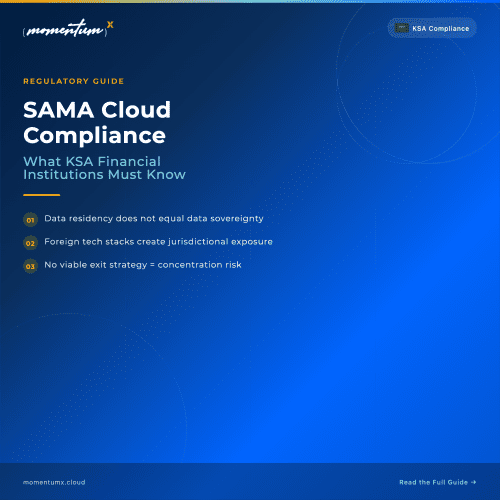
- Saudi Arabia: The NCA’s CCC-2 framework applies to cloud services used by entities in regulated sectors. Logistics operators serving government clients or handling sensitive cargo categories should treat NCA compliance as a procurement prerequisite, not an afterthought.
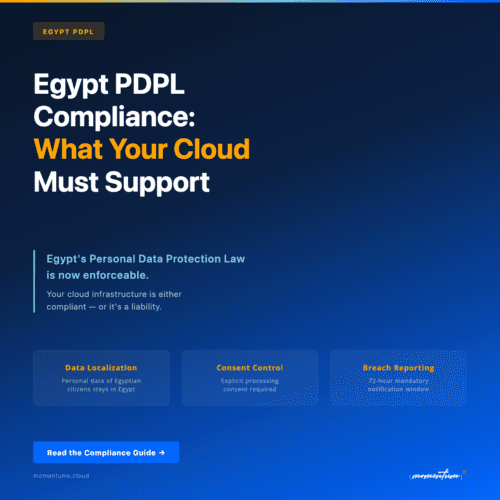
- Egypt: With PDPL enforcement approaching in October 2026, logistics operators running Egyptian operations on foreign-hosted cloud infrastructure need to assess whether their current architecture creates a compliance gap. The answer in most cases is yes.
Disaster Recovery Is an Operational Requirement, Not an IT Project
Logistics operations do not tolerate extended downtime. A warehouse management system that is unavailable for four hours during a peak shipping window creates cascading delays that take days to resolve. A fleet management platform that loses connectivity during a customs inspection cycle generates fines, demurrage charges, and damaged client relationships. The disaster recovery posture of the cloud infrastructure underpinning these systems is therefore a direct operational risk, not a secondary IT concern.
Effective disaster recovery for logistics workloads in MENA requires several capabilities that generic public cloud DR offerings do not reliably provide. Recovery time objectives of two hours or less for tier-one operational systems require pre-provisioned standby capacity in a geographically separated but jurisdictionally aligned facility. Data replication must be synchronous for stateful transactional systems and must occur within the same national boundary to maintain regulatory compliance. The DR environment must be tested against production-equivalent load, not synthetic benchmarks, to provide meaningful assurance of recovery capability.
Architecture Patterns That Work for MENA Logistics
Edge-to-Cloud for Distributed Operations
Large logistics operators in the UAE and KSA typically run distributed physical environments — port facilities, inland container depots, last-mile distribution centres. The architecture that serves this model combines edge compute at each facility for latency-sensitive local processing with a sovereign private cloud core for centralised orchestration, reporting, and integration. The edge layer handles real-time event processing — RFID scans, gate camera feeds, vehicle telemetry — while the cloud core aggregates, stores, and analyses that data against operational and financial records. This pattern reduces the bandwidth and latency pressure on wide-area network links while maintaining a single source of truth in a compliant, in-country environment.
API Gateway and Integration Architecture
Modern logistics platforms are integration-heavy. Customs portals, shipping line systems, freight forwarder APIs, and banking platforms all connect to the operational core. An API gateway deployed on sovereign infrastructure gives the operator full control over data flows, rate limiting, authentication, and audit logging for every external integration. That control is precisely what regulators expect to see documented during compliance assessments — and what most public cloud API management services cannot demonstrate to the standard required.
What Logistics Operators Should Evaluate Before Their Next Infrastructure Decision
The complexity of logistics technology environments makes cloud infrastructure selection consequential in ways that simpler workloads do not surface. Before committing to a cloud platform, logistics operators in the UAE, KSA, and Egypt should verify the following.
- Whether the provider can demonstrate in-country physical infrastructure with documented data residency guarantees — not contractual representations that defer to foreign jurisdiction.
- Whether bare metal or dedicated compute options are available for latency-sensitive workloads, and what the provisioning timeline and SLA for those resources looks like.
- Whether the DR architecture has been tested at production load levels, with documented RTO and RPO results, not estimated targets.
- Whether the provider’s compliance posture aligns with sector-specific requirements in their operating markets, including evidence of prior regulatory engagement in UAE, KSA, or Egypt.
The logistics sector in MENA is growing faster than its infrastructure conversation. That gap creates risk for operators who treat cloud as a commodity procurement decision rather than a strategic infrastructure choice with direct operational and regulatory consequences.
Ready to move to sovereign cloud?
MomentumX provides sovereign cloud infrastructure across Egypt, KSA, and UAE with full SAMA, NCA, and PDPL compliance. Your data stays in your country.
Enterprise Private CloudHyperAI
GPU Compute for AIHyper Private Cloud
Managed Private Cloud